

Data entry outsourcing means handing the entry, updating and checking of records to an outside team that works to your rules, in the systems you choose.
For many US operations teams, that work is CRM updates, order and contract entry, and spreadsheet cleanup. Below: which of it to hand off, the three ways to buy it, how a dedicated agent works inside your systems, how to limit what the outside team can see, how to check accuracy, and what it costs.
What data entry work is worth outsourcing
Before you outsource data entry, list the tasks your team repeats every week and where the information for each one comes from. Work that is worth handing off has clear rules, arrives on a regular schedule and can be written down as "this field comes from that document."
| Task | Where the information comes from | Where it goes | What to keep in-house |
|---|---|---|---|
| CRM record updates | Emails, web forms, call notes, spreadsheets | Your CRM | Decisions about deal stage or account ownership |
| Order entry | Purchase orders, emailed orders, marketplace exports | Your order or ERP system | Credit holds, pricing exceptions, refunds |
| Contract details | Signed agreements and amendments | Your contract tracker or transaction system | Interpreting terms and approving changes |
| Listing and catalog updates | Product sheets, supplier files, listing changes | Your website, marketplace or MLS | Pricing decisions |
| Spreadsheet cleanup | Exports from several systems | A cleaned master file | Deciding which record wins when two conflict |
| Form and portal submissions | Applications and supporting documents | Third-party portals with no API | Anything that needs your signature |
CRM data entry services are a common first step. The rules are easy to write down: which fields to fill, which source wins when two disagree, and what to do with duplicates. Order processing and contract entry usually come next. Bulk data processing, where software extracts fields from documents, is a different job; the next section covers when it is the better choice.
What to keep in-house or automate
Clean, fixed-format documents, such as typed invoices or standard forms, are often cheaper to handle with automation. OCR or an extraction tool reads the fields, and a person checks the exceptions. People are still better at three kinds of work:
- Documents that vary in layout or handwriting, where someone has to decide which field a value belongs in.
- Third-party portals with no API, where every entry has to be typed into a web form.
- Checking an entry against the source document and following up when something does not match.
O*NET, the US Department of Labor's occupation database, projects employment of data entry keyers to decline between 2025 and 2035. The same profile lists comparing data with source documents, or re-entering it in a verification format to detect errors, among the job's tasks.
Keep two kinds of work in-house: anything that depends on a business decision, such as approving a refund or interpreting a contract clause, and one-off cleanups you cannot yet describe as rules.
Three ways to buy data entry help
Data entry outsourcing services come in three main forms. They differ in what you pay for, who manages quality and where your data sits while the work is done.
| Way to buy | What you pay for | Who manages quality | Where the data sits | Best fit |
|---|---|---|---|---|
| Data entry company paid per record | Each record, page or project | The vendor, using its own process and tools | Usually the vendor's environment, sent as files | High-volume batches of uniform records, such as scanned forms |
| Freelancers | Hours or a fixed fee, plus platform fees | You | Wherever you give access | One-off cleanups you can define and check yourself |
| Dedicated agent | Agent hours | You set the rules; the provider supervises and covers absences | Your systems, under logins you create | Ongoing work across several systems that needs judgment |
A per-record price is cheapest when each record takes seconds. When a record takes minutes, because someone has to open three systems or chase a missing field, an hourly price is easier to control. Ask any per-record quote how many minutes per record the price assumes.
Some providers call the dedicated option a data entry specialist or an assistant. Either way, the same person works your queue every day. If you are also weighing shared and dedicated agents for customer service, see shared or dedicated customer service.
What a dedicated data entry agent does inside your systems
Outsourced data entry services built on a dedicated agent work differently from sending files to a vendor: the agent logs into your systems and works through your queue. One example from Callnovo's work: a dedicated data entry virtual assistant for a US real estate brokerage updates MLS listings and enters contract details in the brokerage's own systems.
In any industry, the first weeks of a remote agent working in your systems usually follow the same steps:
- Access. You create a named login for the agent in each system and open only the modules the task needs.
- Intake. Documents arrive in one place, such as a shared inbox or a queue, and the agent enters them against a written field list.
- Exceptions. When a field is missing or two documents disagree, for example on a price or a closing date, the agent asks the same day instead of guessing.
- Cover. When the agent is on leave, a colleague covers the queue. If the fit is wrong, Callnovo replaces the agent at no charge.
Because the work happens in your own workflow, any system that keeps a change history shows each edit under the agent's login, so you can see who changed a record and when.
Callnovo provides these agents as dedicated remote assistants and records their attendance and takes screenshots at set intervals, with reports on work hours and software use; see screenshots and attendance monitoring. For other real estate work that suits an assistant, see real estate tasks to delegate.
Decide what data the outside team will see
An outside team only needs the fields that the task uses. Set that up before the first record is entered:
- Give each person a named login and never share passwords. Turn on multi-factor authentication wherever the system supports it.
- Grant access on a "need to know" basis, as the Federal Trade Commission's security guide for businesses recommends (FTC, 2023). Open only the modules and fields the task uses.
- Keep payment data out of scope. Card numbers and bank account numbers rarely need to pass through data entry. Remove them from the documents you send or hide those fields, and let your own payment system handle payments.
- Write your security expectations into the contract and keep checking them during the work. The same FTC guide tells businesses to state their expectations before hiring a service provider and to build oversight into the process.
- Remove access on the day the work ends.
Ask where the agents work and on what devices. At Callnovo, 90%+ of agents are office-based rather than working from home. If a provider says it follows a security framework, ask to see the report itself and which systems it covers. Callnovo works aligned with ISO 27001 and SOC 2 framework practices.
How to check accuracy before you scale
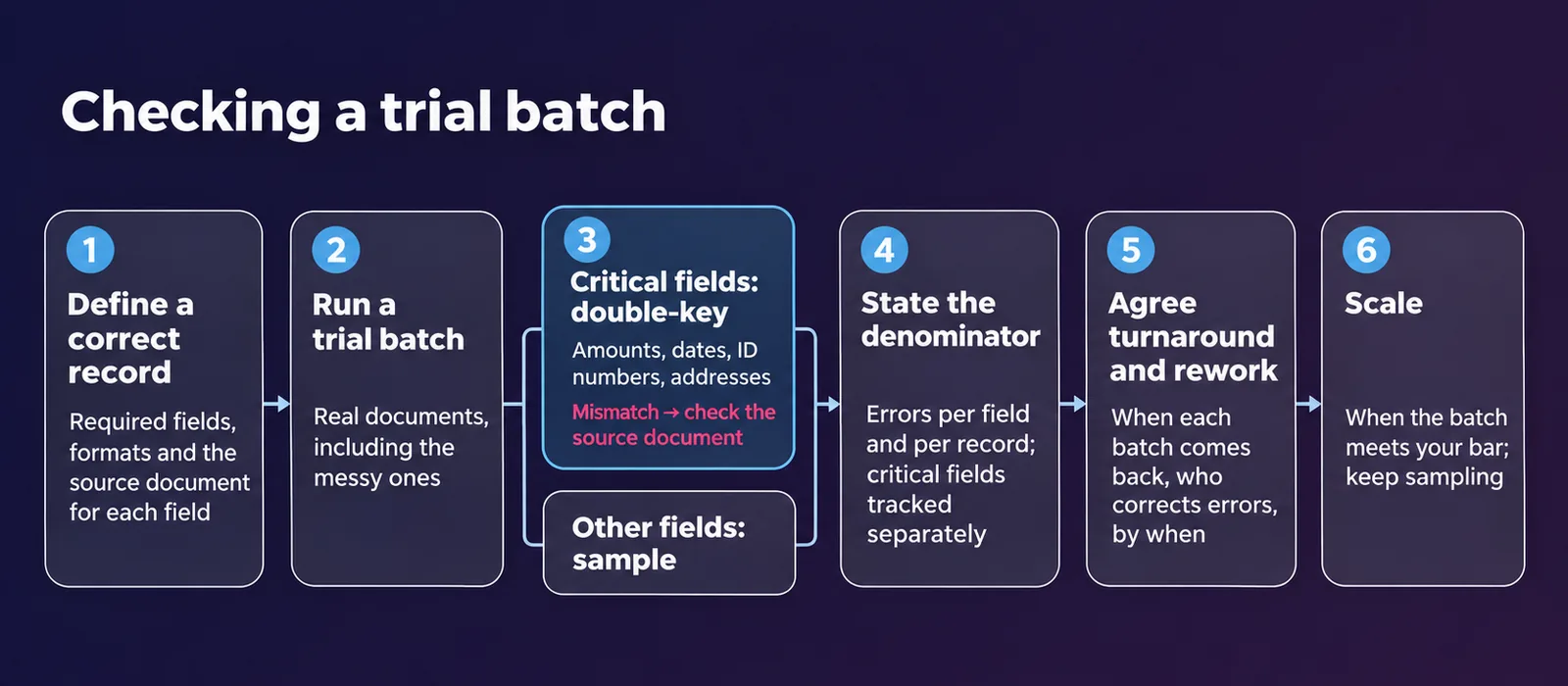
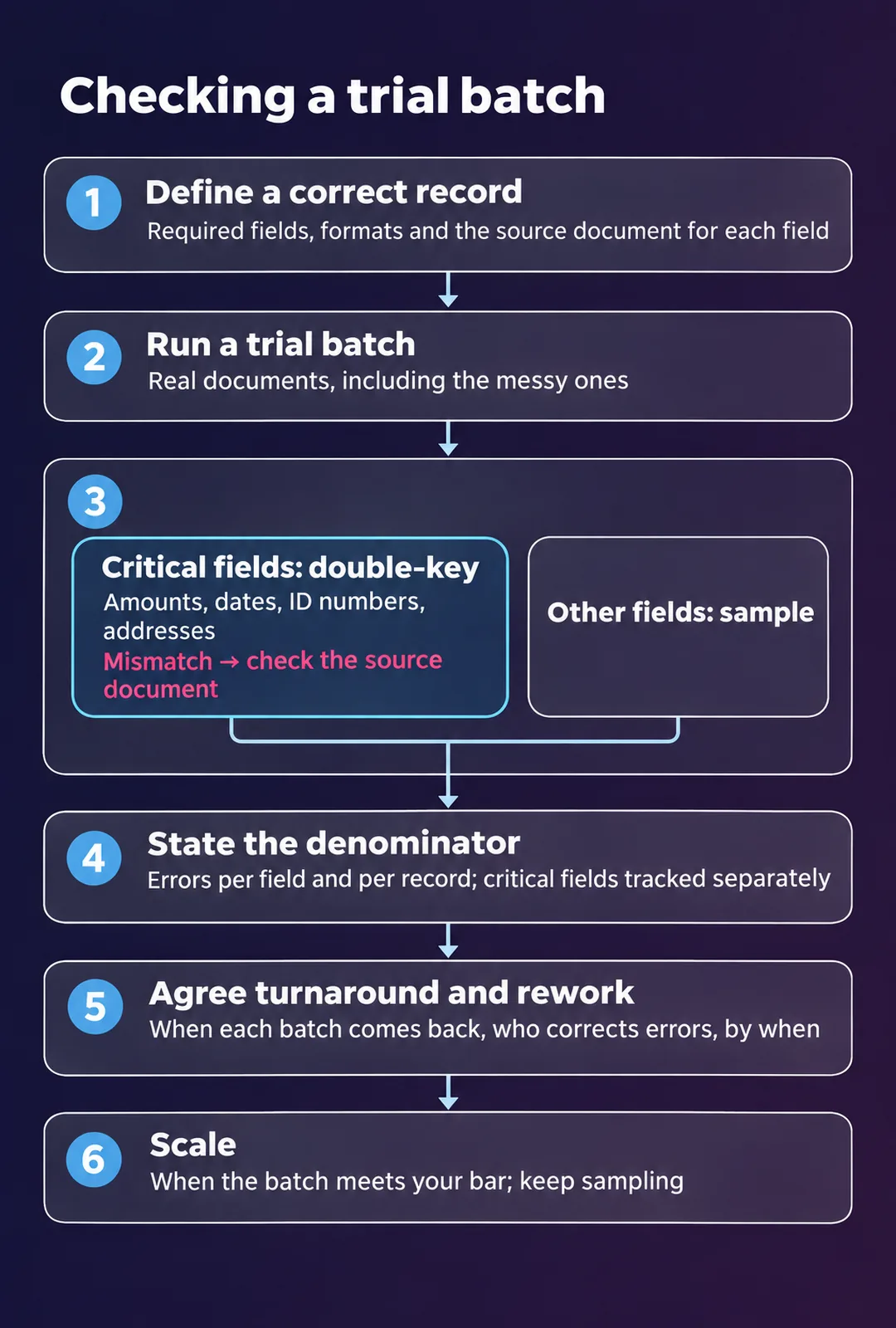
An accuracy figure such as "99.9%" tells you little until you know what counts as an error and what it is divided by. Check the work yourself on a trial batch:
- Define a correct record. List the required fields, their formats and which document is the source for each field.
- Run a trial batch of real documents, chosen to include the messy ones.
- Double-key the critical fields. For amounts, dates, ID numbers and addresses, two people or two passes enter the same field independently, and every mismatch is checked against the source document. Sample the remaining fields.
- State the denominator. Count errors per field and per record, and track critical-field errors separately. A record with one wrong delivery date still fails, even if every other field is right.
- Agree turnaround and rework. Write down when each batch comes back and who corrects errors, by when.
- Scale when the batch meets your bar, then keep sampling as an ongoing quality check.
Re-reading entries does not replace double entry. In a study of 195 undergraduates randomly assigned to double entry, visual checking or single entry, visual checking produced 2,958% more errors than double entry and was not significantly better than single entry with no check (Barchard and Pace, 2011).
The participants entered research data sheets. The same logic applies to business records: for the fields that matter, compare two independent entries instead of asking someone to look again.
What data entry outsourcing costs
Callnovo prices dedicated agents by the hour. A dedicated English agent starts at US$5.80 per hour per person, covering weekdays from 9 a.m. until 5 p.m. Eastern Time. Paid hours, training, supervision, absence cover and any extra shifts are agreed in the quote, and languages other than English have their own rates or are quoted per project. See Callnovo pricing for the full table.
What it costs compared with hiring
Data entry keyers in the US earned a median of $19.88 an hour, based on BLS 2025 wage data. Benefits add to that: across private industry, they accounted for 30.0% of what employers spent on compensation in June 2026 (BLS, 2026). Dividing the wage by 0.70 gives an estimated loaded cost of about $28.40 an hour, before equipment, space and supervision.
| Option | Hourly figure | What it covers |
|---|---|---|
| US in-house hire | $19.88 median wage; about $28.40 with benefits (estimate) | Wage and benefits; you add equipment, space and supervision |
| Callnovo, English-speaking dedicated agent | US$5.80 and up | Agent hours on weekdays, 9–5 Eastern; paid hours and extra shifts set in the quote |
| Per-record vendor | A price per record | Convert it with the formula below |
To compare an hourly price with a per-record price, convert both to the cost of one record:
Cost per record = hourly cost × minutes per record ÷ 60
At $28.40 an hour, a record that takes 3 minutes costs about $1.42, and one that takes 30 seconds costs about $0.24. At Callnovo's starting rate of US$5.80, the same records cost about $0.29 and $0.05. Use the times from your own trial batch, not a vendor's average.
When your volume doesn't fill a full-time seat
Many small teams have 10 or 20 hours of data entry a week, not 40. You do not have to choose between a per-record vendor and a full-time hire. For steady work, buy only the hours you need; for a one-off backlog, a per-record vendor is usually the better fit.
Ask any provider two things: the minimum hours it will commit to, and the unit it bills in. With Callnovo, the minimum engagement is half a seat and paid hours are agreed in the quote. Hiring takes about 3 business days for 1 to 5 agents, with training on top.
How to choose among data entry outsourcing companies
A list of data entry outsourcing companies is only a starting point. To find one that fits your work, ask each provider the same questions:
- Who will enter the data, and where do they work: which delivery location, and in an office or at home?
- Will the work happen in our systems or yours, and how are logins opened and removed?
- How do you count an error, per field or per record, and will you run a trial batch on our documents?
- If you price per record, how many minutes per record does the price assume?
- Who fixes errors, and how long does a batch take to come back?
- What happens when the agent is on leave or leaves?
- Can you show the security report itself, and which systems does it cover?
For comparison, Callnovo's answers:
- Dedicated agents billed by the hour, from a minimum engagement of half a seat, growing to 200+ agents for a single client, working in your systems under named logins.
- Leave cover and free replacement.
- 90%+ office-based agents.
- Operations aligned with ISO 27001 and SOC 2 framework practices.
- English starting at US$5.80 for each agent hour.
- 65+ languages covered by human agents.
Callnovo has operated since 2004, with headquarters in Toronto and 26 delivery countries.
Before you send the first file
To get a quote that matches your work, prepare five things:
- Your weekly or monthly volume, and any seasonal peaks.
- Sample source documents in each format you use: PDFs, scans, emails, spreadsheets.
- The systems the work touches and the access each one needs.
- Your definition of a correct record and the critical fields.
- The data that must stay out of scope, such as card and bank account numbers.
Send them with your quote request so the price reflects the work you actually have.
References
- O*NET OnLine (U.S. Department of Labor), Data Entry Keyers 43-9021.00: national wages (BLS 2025 wage data) and summary report (2025–2035 projections)
- BLS, news release on employer compensation costs per hour worked, June 2026 data, released September 9, 2026
- Barchard, K. A., & Pace, L. A. (2011). Preventing human error: The impact of data entry methods on data accuracy and statistical results. Computers in Human Behavior, 27(5), 1834–1839
- Federal Trade Commission, Start with Security: A Guide for Business (August 2023)