

Call center pricing is quoted in four different units, so three proposals can each look cheap and still produce very different monthly bills. One provider quotes per agent hour, another per minute, a third per call. To compare them, price each one against the same month of work: your call volume, how long calls take, the hours you need covered and how fast calls must be answered.
"How much does it cost to outsource customer service?" has no single answer, because the price follows your workload. This guide shows the conversion step by step, works through 10 and 30 calls a day at Callnovo's published starting rates, and puts an in-house agent hour beside it using Bureau of Labor Statistics data.
How call center pricing models work
How much does a call center cost? Start with the billing unit, because there is no standard price until you know what is being billed. Each of the four call center pricing models below buys something different and leaves the cost of quiet time with a different party.
| Billing unit | What you pay for | Who pays for quiet time | Suits this kind of volume |
|---|---|---|---|
| Per agent hour | Agent time scheduled on your account | You: idle hours are billed | Steady volume, or coverage you must hold whatever the call count |
| Per minute | Billable minutes on your calls | The provider, but the definition of a minute sets your price | Low or uneven volume |
| Per call or per contact | Each handled call, email or chat | Shared; it depends on what counts as one contact | Spiky volume with similar contact types |
| Per resolution | Each issue the provider resolves | The provider, once "resolved" and the reopen window are written down | Contacts with a clear, checkable outcome |
Call center rates also change by channel. Phone work is usually billed by the minute or the hour, while email, chat, social messages and tickets are often billed per interaction. That split matters when you estimate customer service cost across channels: a long chat costs the same as a short one under per-interaction billing, while a long phone call costs more under per-minute billing.
What does one minute cost? It depends on whether you buy minutes one at a time or in a bundle. Callnovo lists phone support from US$1 a minute. Its shared English package starts at US$650 a month and includes 1,500 minutes. Used in full, that works out to about US$0.43 a minute, the per-minute equivalent Callnovo lists for the package. A call center cost per minute figure only compares fairly once you know which kind of rate it is.
Some per-seat prices are for contact center software: a license that lets your own agents use a phone system or help desk. That is a different purchase from staffed service. This guide covers staffed service; for platform license prices, see our contact center pricing comparison.
What decides how many hours you pay for
Many hourly quotes are built from your call minutes: total talk time divided by the share of time an agent can be kept busy. That method assumes staff can be added or removed as volume moves. A dedicated agent is billed differently. You pay for the hours the agent is scheduled on your account, and two things set those hours: the coverage window, and the service level you expect inside it.
Coverage hours set a floor
An hourly rate becomes a monthly bill with one formula: weekly hours × 52 ÷ 12.
- A weekday position, 40 hours a week, is 40 × 52 ÷ 12 ≈ 173 hours a month.
- A 24/7 position is 168 × 52 ÷ 12 = 728 hours a month. That is the hours of 4.2 weekday positions, before anyone's vacation, sick days or training are covered.
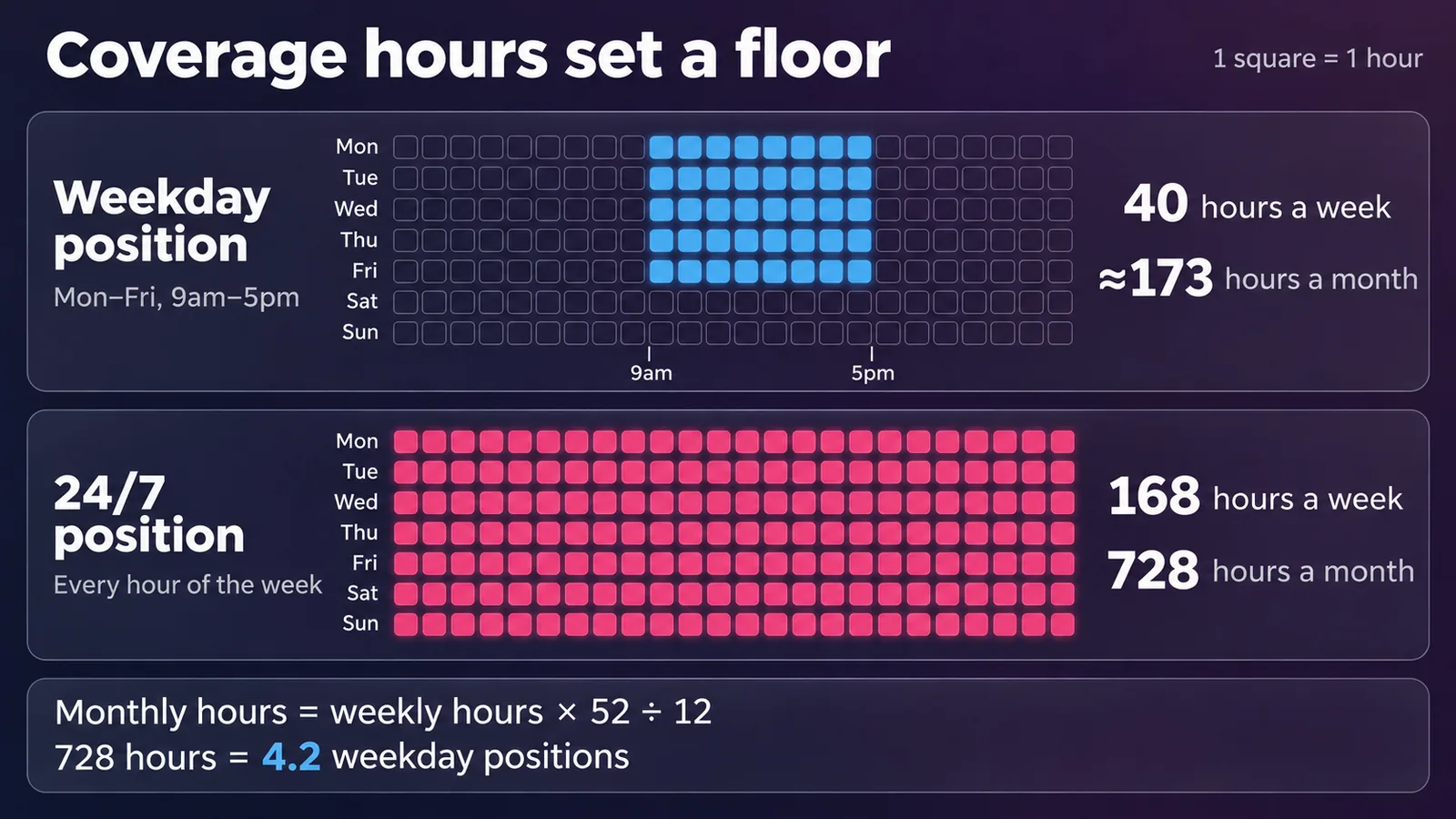
Each row is one day and each square one hour; the lit squares are the hours you pay for.
You pay for those hours whether the phone rings or not. When few calls arrive, the fixed hours are spread across fewer calls and the cost of each call goes up. The worked example below shows the effect at 10 and 30 calls a day.
The quickest way to reduce call center costs on an hourly contract is often to stop paying for hours nobody calls in. Pull three months of calls by hour of day and day of week before you set the coverage window. If evenings or weekends bring only a handful of calls, price that window on its own terms instead of staffing it like a weekday.
At Callnovo, after-hours coverage is priced separately. Its published shared package is English phone answering on weekdays, 9am to 5pm Eastern; evenings, weekends and 24/7 are scoped for each project. The dedicated agent rate, from US$5.80 per hour, is likewise a weekday starting rate. One agent's hourly rate does not buy round-the-clock staffing.
Service level targets decide how many agents are on at once
The 80/20 rule in a call center is a service level target: 80% of calls answered within 20 seconds. The tighter the target, and the more your calls bunch together, the more agents need to be on the phones at the same time, even when daily volume is modest.
The table below illustrates this with Erlang C, the standard queueing formula for call centers. It assumes calls arrive at random, each one takes 5 minutes including wrap-up, and callers wait rather than hang up.
| How 30 calls arrive | 1 agent: share answered within 20 seconds | 2 agents | 3 agents | Agents on at once to reach 80/20 |
|---|---|---|---|---|
| Spread evenly over 8 hours | 70% | 96% | 99.7% | 2 |
| Half of them in two peak hours | 39% | 86% | 98% | 2 during the peak |
| All 30 within two hours | Queue keeps growing | 54% | 86% | 3 during the peak |
| For comparison: 10 calls spread over 8 hours | 90% | 99.5% | — | 1 |
These figures illustrate the formula; they are not a staffing plan. Erlang C leaves out callers who hang up while waiting, so it tends to overstate the staff you need slightly.
The table explains why one dedicated agent may not be enough for 30 calls a day if you hold an 80/20 target. It also shows the limit of pushing occupancy, the share of an agent's available time spent handling calls, as high as it will go. An agent who is busy every minute leaves the next caller waiting, and the service level drops. Our guides to call center service level and occupancy explain how to measure both.
How to compare call center quotes on the same month of work
Turn every quote into a monthly bill for the same workload, then divide by the calls handled and the issues resolved. Four steps get you there.
- Write down the workload. Record calls per month, average handle time including after-call work (the notes and follow-up after a call ends), the coverage window, the busiest hours, channels and languages. Use your own hourly call data from the last three months, and give every provider the same figures.
- Convert each quote to a monthly bill. Use the formulas in the table below. This gives you one call center cost per month for each option.
- Divide by what you get. Call center cost per call is the monthly bill divided by calls handled. Cost per resolution divides the same bill by issues resolved. A cheaper hour that produces more repeat calls can cost more per resolution.
- Check the definitions behind each number. Ask what counts as a billable minute, how time is rounded, whether there is a minimum monthly commitment, and what setup and training cost.
| Quote type | Monthly bill | Ask the provider |
|---|---|---|
| Per agent hour | Rate × hours covered per month × agents on at once | Paid hours, absence cover, after-hours rates |
| Per minute | Rate × billable minutes per month | Whether hold time and after-call work are billed, rounding, any minimum charge |
| Per call or contact | Rate × calls per month | What counts as one call: transfers, voicemail, hang-ups |
| Per resolution | Rate × resolved issues per month | The definition of "resolved" and the reopen window |
| Package | Package price + overage | Included minutes or contacts, and the overage rate |
A call center outsourcing cost comparison only holds when every provider priced the same workload. If one quote assumes 4-minute calls and another 6, you are comparing assumptions, not prices. The same four steps work whether you are estimating customer service outsourcing cost for one phone queue or for phone, email and chat together.
Worked example: pricing 30 calls a day three ways
Thirty calls a day sounds small, but at 5 minutes a call it is about 3,300 minutes of phone work a month. That is enough for a dedicated agent to cost less than per-minute billing.
The example assumes each call takes 5 minutes including after-call work, there are 22 workdays a month, and every call is in English between 9am and 5pm Eastern on a weekday. Prices are Callnovo's published starting rates. Phone support is from US$1 a minute, the shared package is from US$650 per month with 1,500 minutes included, and a dedicated agent is from US$5.80 per hour.
- 10 calls a day: 10 × 5 × 22 = 1,100 minutes and 220 calls a month.
- 30 calls a day: 30 × 5 × 22 = 3,300 minutes and 660 calls a month.
| Billing option | 10 calls a day | 30 calls a day | Cost per call at 30 a day |
|---|---|---|---|
| Per minute, from US$1 | about US$1,100 | about US$3,300 | US$5.00 |
| Shared package, from US$650 with 1,500 minutes | US$650 | Above the included minutes; quoted | Quoted |
| One weekday dedicated agent, from US$5.80 per hour | about US$1,005 | about US$1,005 in agent time | about US$1.52 in agent time |
The break-even point is US$1,005 ÷ US$1 a minute, or about 1,005 minutes a month. That is roughly nine five-minute calls each workday. Below it, per-minute billing costs less than a dedicated seat. Above it, the dedicated seat is cheaper, at least up to the 1,500 minutes listed with that tier. The shared package costs less than per-minute billing between 650 and 1,500 minutes.
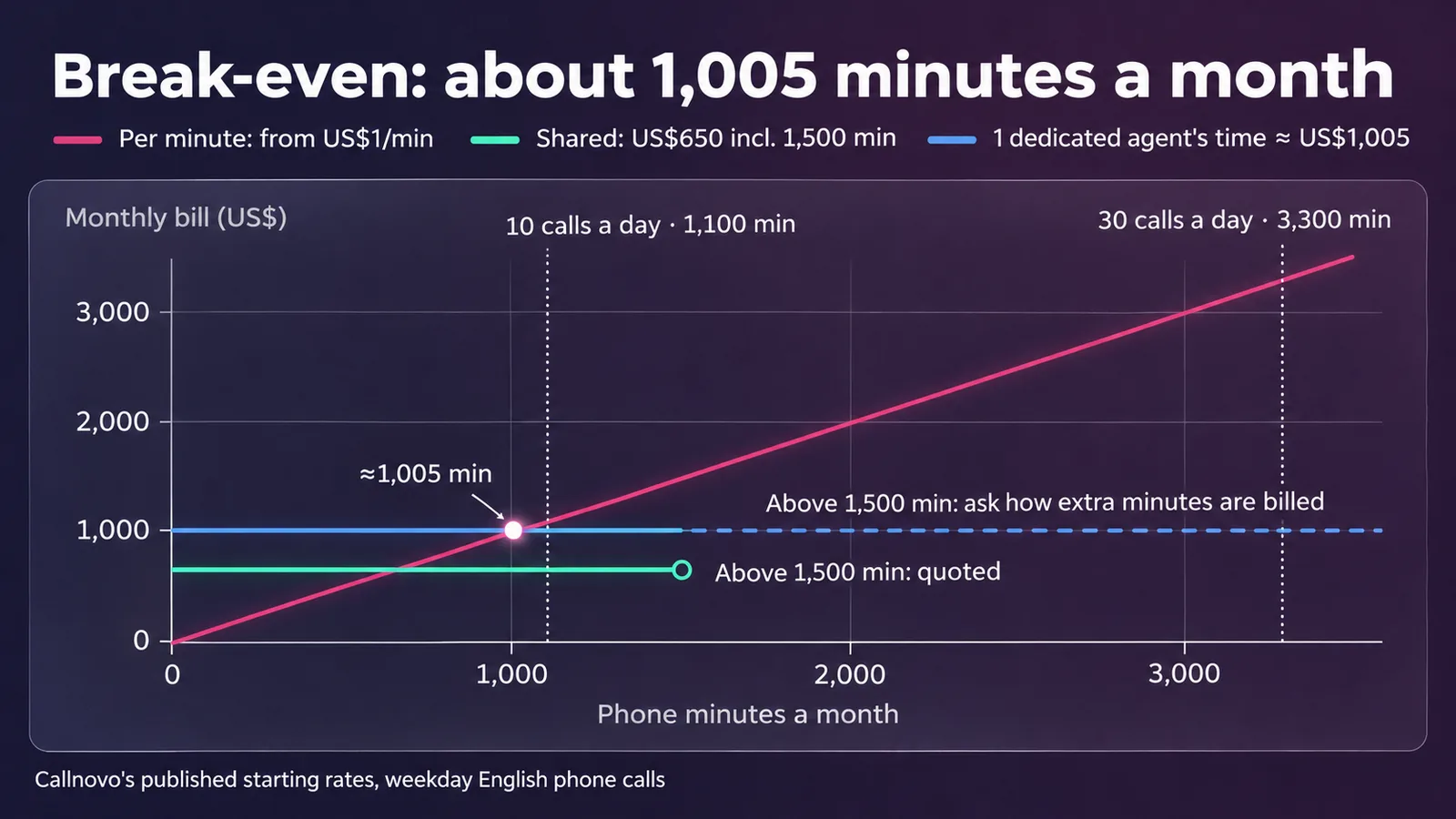
Same assumptions as the table: 5-minute weekday English calls, 22 workdays a month, Callnovo's published starting rates.
Three conditions shape the result.
The US$1,005 is agent time at the starting rate. Callnovo's price page lists 1,500 minutes of communication charges with the dedicated English tier. At 3,300 minutes you are past that allowance, so ask how the extra minutes are billed before you treat US$1,005 as the full bill for the month.
The shared package has a specific job. Callnovo staffs its standard projects with non-shared agents and assesses a shared arrangement for overflow, backup or low-volume coverage. That fits the 10-calls-a-day case.
Timing matters too. Under the illustrative 80/20 assumptions in the previous section, 30 evenly spread calls need two agents on at once. That doubles agent time to about US$2,011 a month, still below US$3,300 of per-minute billing.
Which option gives the lowest call center outsourcing cost comes down to where your minutes fall against these break-even points, more than to the headline rate. For more on when each model fits, see shared or dedicated support.
What an in-house agent hour really costs
An in-house agent hour starts at the wage: US customer service representatives earned a median hourly wage of $21.53 in May 2025 (Bureau of Labor Statistics, 2025). Everything else an employer pays for that hour comes on top, and you have to build those lines from your own budget.
The $21.53 comes from the BLS Occupational Employment and Wage Statistics survey, and it is pay only. The survey leaves out overtime and what employers spend on benefits. At 173 hours a month, the wage alone comes to about $3,730 per position.
Wages are only part of what an employer spends on a person. In the BLS Employer Costs for Employee Compensation release for June 2026, wages and salaries made up 68.7% of what private employers spent on compensation for office and administrative support occupations, the group that includes customer service representatives (Bureau of Labor Statistics, 2026). Benefits made up the other 31.3%: paid leave, supplemental pay, insurance, retirement and legally required benefits.
The two figures come from different surveys and periods, so keep them as separate reference points rather than combining them into one hourly rate. Then build the rest of your in-house call center costs line by line. These call center expenses sit outside both BLS figures:
| Cost line | Covered by the BLS figures? | How to estimate it |
|---|---|---|
| Wages | Yes: $21.53 median hourly wage, May 2025 | Your local pay rate for the role |
| Benefits | Shown as a share: wages are 68.7% of compensation for the occupational group | Your benefits and payroll tax load, from finance |
| Paid hours off the phones (training, meetings, breaks) | No | The share of paid hours not available for calls, often called shrinkage |
| Supervision and quality review | No | Team lead and QA time per agent |
| Recruiting and onboarding | No | Hiring cost, plus the weeks before a new hire takes calls alone |
| Technology: phone system, CRM, call recording | No | Per-seat licenses and telephony minutes |
| Workspace and equipment | No | Desk, headset and computer, or a remote setup |
| Your management time | No | Hours your team spends on hiring, scheduling and escalations |
When a provider quotes call center cost savings, ask which of these lines its comparison includes, and check it against the same hours per month. For the full in-house vs outsourcing decision, including the volume at which building your own team pays off, see the in-house vs outsourcing break-even math.
Where call center quotes hide cost
Call center outsourcing pricing often leaves costs off the rate card. Those outsourcing costs sit in definitions and conditions: what a minute is, what a month must include, what changes cost extra. Before you compare totals on call center services pricing, ask about these call center fees and terms.
| Ask the provider | Why it changes the bill |
|---|---|
| What counts as a billable minute: queue time, hold, after-call work? | The same call can bill for more minutes |
| How is time rounded: per second, per 6 seconds or per minute? | Rounding every call up adds minutes |
| Is there a minimum monthly commitment? | A slow month still pays the minimum |
| Are setup, training or script changes billed? | One-time and change fees add to the first month and to every update |
| Do nights, weekends and holidays cost more? | Hours outside the standard window may carry a different rate or a separate scope |
| How are languages priced? | At Callnovo, for example, English–Spanish bilingual support is quoted per project; see multilingual pricing |
| What does "resolved" mean, and when does a reopened issue count again? | A per-resolution bill depends on that definition |
| Is software included in the seat price? | You may already pay for the same CRM or recording tool |
| How many phone minutes are included, and what does the overage cost? | Seats and packages can carry minute allowances |
| How do you scale down or exit? | Fixed seats keep costing money in a slow season |
Where Callnovo's starting rates fit
Callnovo publishes starting rates for its shared, dedicated, per-minute and per-interaction options, so you can run the steps above with real numbers before you ask for a quote.
| Option | Starting rate | What the listing includes | Suits |
|---|---|---|---|
| Shared English team | From US$650 per month | Phone answering on weekdays, 9am to 5pm Eastern, with 1,500 minutes of communication charges | Overflow, backup or low volume |
| English dedicated agent | From US$5.80 per hour | Phone answering on weekdays, 9am to 5pm Eastern, with 1,500 minutes of communication charges | Standard projects with ongoing work |
| Phone support | From US$1 a minute | Phone support, billed per minute | Low or uneven volume |
| Email, chat, social or ticket | From US$0.20 an interaction | Each interaction billed separately | Non-voice channels |
Dedicated engagements run half a seat to 200+ seats. As an example, a half seat at 20 hours a week is about US$503 a month at the starting rate. Other languages and English–Spanish bilingual support are quoted per project, and evenings, weekends and 24/7 are scoped separately. The shared and dedicated tiers are listed on the Callnovo price page; per-minute and per-interaction rates are on the Callnovo.ai pricing page.
To get a quote that matches your own math, send the inputs from step 1: three months of calls by hour, average handle time, the coverage window and the languages you need.
Before you sign a call center pricing agreement
Before you sign, check that the contract or statement of work spells out each of these:
- The workload assumptions: calls per month, handle time, coverage window and peak hours.
- The billing definitions: what a billable minute is, how time is rounded, and what counts as a call or a resolution.
- Prices for nights, weekends and holidays, if you need them.
- The service level target, how it is measured and what happens when it is missed.
- Any minimum monthly commitment.
- Included phone minutes and the overage rate.
- A trial period, and the terms for scaling down or exiting.
For a fuller template to send to providers, use our call center outsourcing RFP.
FAQ
What are the startup costs of a call center?
For an in-house team, startup costs include recruiting, phone numbers and telephony, licenses for a CRM and call recording, workspace and equipment, and the training period before new agents take calls alone. For an outsourced team, most of the startup cost is your own staff's time. Someone has to write the specification, build the knowledge base the agents will use and review the early calls. Ask the provider whether setup or training is billed separately.